




If you go into a modern glass-making factory, the Automatic Glass Cutting Assembly Line is likely where most of the work is done. This is a complex system that uses automation to turn raw glass sheets into exactly sized parts. These production lines have filling systems, precise cutting tables, and breaking devices to keep working while work is being done. These assembly lines make quality uniform while greatly increasing output by automating work that used to be done by hand and required a lot of work. At Huashil, we designed the HSL-LSX4228 model to meet the specific needs of companies that make architectural glass, curtain wall systems, and furniture and are looking for stable, high-capacity continuous processing solutions.
Understanding Automatic Glass Cutting Assembly Lines
Modern Automatic Glass Cutting Assembly Line processing is a big step forward from the old ways of cutting glass by hand. The technology behind these systems is made up of many specialized parts that work together in sync.
Core Components and Workflow Integration
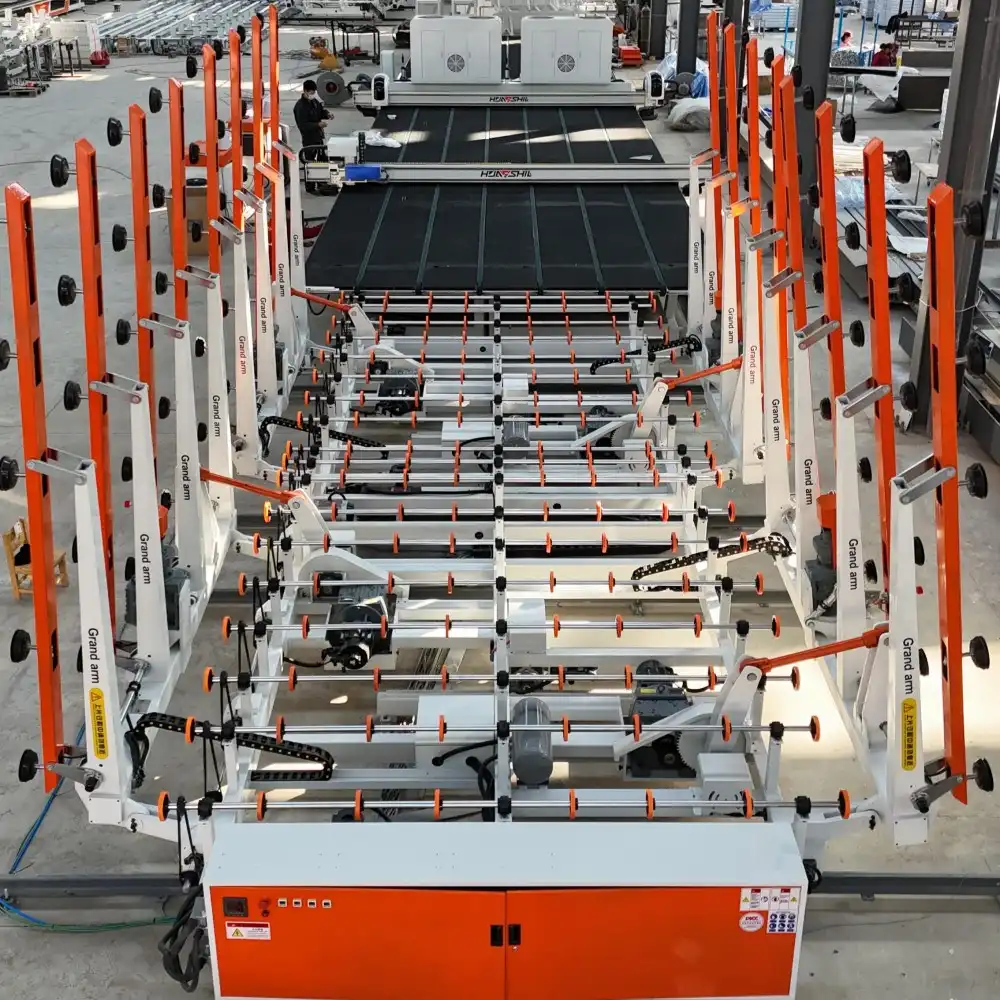
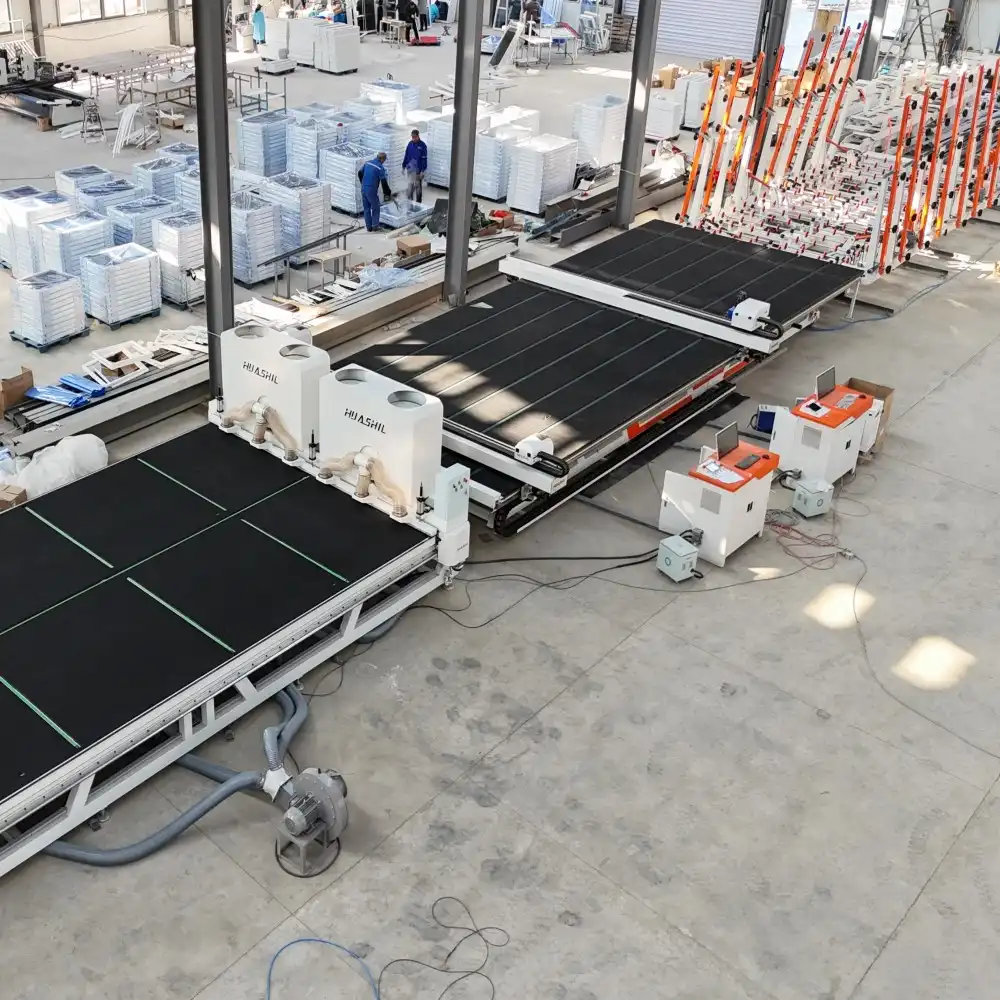
Three functional sections work in order on an Automatic Glass Cutting Assembly Line. Raw glass sheets are placed appropriately on the filling table for processing. Four huge arms on each side allow our HSL-LSX4228 to handle glass sheets up to 4200x2800mm, which is large enough for most industrial and construction needs.
All precision work is done on the cutting table. This section employs CNC-controlled cutting equipment to execute complex optimisation software-created cutting patterns. Our systems use Optima software to determine the optimal method to cut each sheet of glass. Smart planning reduces waste far more than hand-making patterns.
The breaking table applies calibrated pressure along scored lines to separate parts easily. With three tables set up this manner, workflows can constantly run and each spot can work on multiple sheets of glass at once, improving output.
Rail Systems and Station Configurations
The infrastructure for continual processing is built with precision rail systems. HSL-LSX4228 provides above-ground and subterranean rail options, so manufacturers may customise the installation to their building layout and workflow.
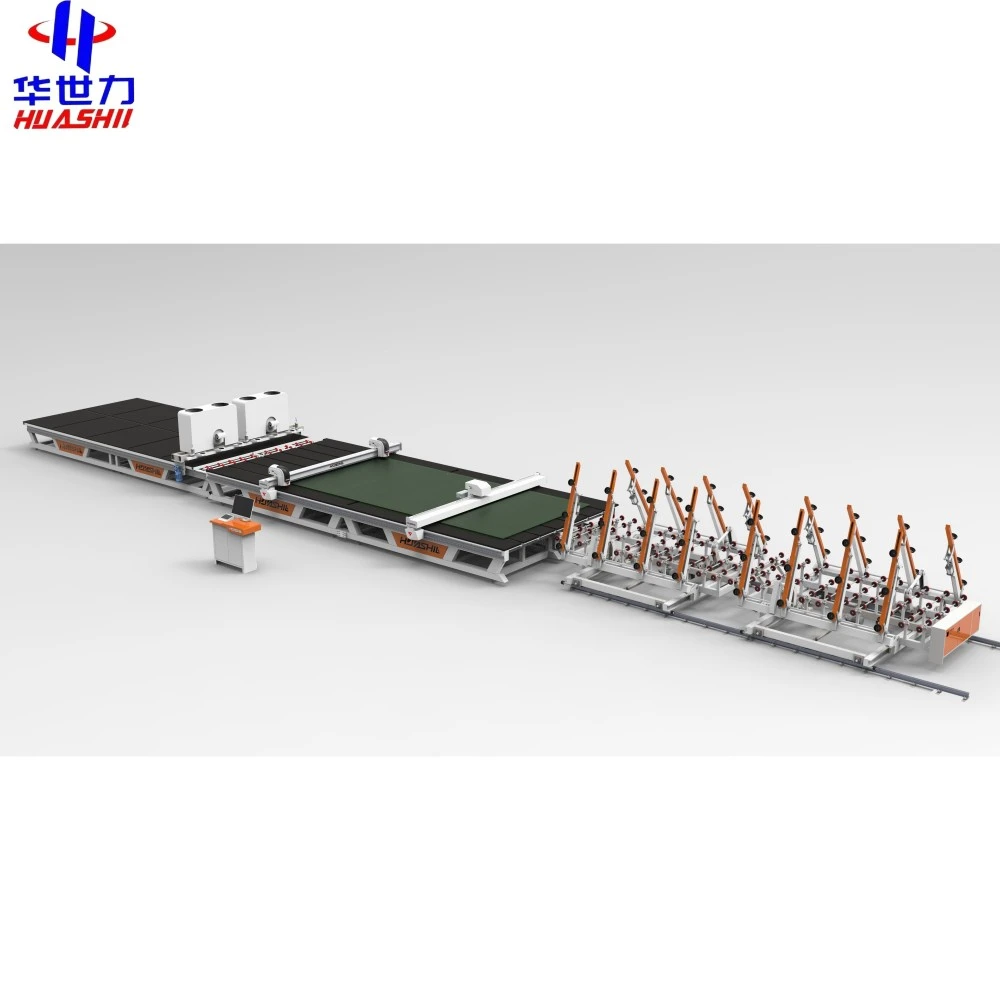
The 2+2 station design is flexible, giving you additional production planning alternatives. This setup has two loading/dumping and two processing areas. This allows workers to prepare the next batch as the system processes the current one. This simultaneous process eliminates batch breaks, preserving the continual working benefit that distinguishes automated lines from semi-automatic ones.
Semi-Automatic versus Fully Automatic Systems
Buyers may make sensible spending decisions by understanding automation's range. Persons must operate semi-automatic lines for loading, unloading, and quality checks between automated cutting rounds. Although cheaper to set up, these solutions can't manage as much work.
Fully Automatic Glass Cutting Assembly Lines like our HSL-LSX4228 decrease machine touch during manufacturing. With little human input, the system places, optimises, cuts, breaks, and sorts glass sheets on the loading table. This technology reduces labour expenses significantly and makes the workplace safer by preventing cutting activities.
Benefits of Automatic Glass Cutting Assembly Lines for Continuous Processing
When you invest in Automatic Glass Cutting Assembly Line technology, you get measured results in several operating areas. Knowing about these perks helps make the case for spending money on capital during the budget approval process.
Enhanced Efficiency and Throughput
Continuous processing design significantly alters output capacity estimations. Due to the time required to load, set up patterns, and empty by hand, conventional batch processing constantly breaks between production cycles. Automated continuous lines handle breakdowns.
Data from building glass companies suggests that automated continuous processing may increase daily productivity by 40–60% over semi-automatic equipment cutting at the same speed. This advantage comes from not needing to wait for cuts and not cutting more quickly. Technology that saves 10 minutes an hour will add approximately three hours to your 16-hour-a-day manufacturing line.
This benefit is enhanced by a multi-station arrangement. Workers add the next glass sheet at a different stand while cutting the first. The overlapping process keeps tools regularly employed, which buying teams should consider when determining when their expenditures will pay off.
Precision, Consistency, and Waste Reduction
Human procedures can't match automated systems' measuring precision. CNC-controlled cutting heads maintain tolerances of ±0.5mm for thousands of cuts, ensuring precise part placement.
Consistency encompasses both piece accuracy and batch-to-batch repeatability. When creating 500 identical curtain wall panels, the Automatic Glass Cutting Assembly Line systems copy the cutting pattern identically. Dependability reduces installation and guarantee claims, which aren't always visible when comparing equipment pricing.
Material tuning is another benefit. To maximise glass production, the Optima software analyses glass sheet sizes and determines the optimal cutting methods. Industry studies suggest that employing advanced optimisation tools instead of hand-planning patterns reduces waste by 8–15%. This optimisation saves 16 to 30 tonnes of garbage per year for plants that handle 200 tonnes of glass per month, making it sustainable and cost-effective.
Energy Efficiency and Operational Cost Reduction
Modern Automatic Glass Cutting Assembly Line technologies save energy and money beyond labour. Variable-frequency drives adjust motor speed for processing. This lets the motors use power just when needed instead of running at full speed.
Integrated cutting lines save energy since they are smaller. Floor area increases heating, cooling, and lighting demands. Small Automatic Glass Cutting Assembly Line devices can perform more in less space than distributed manual workstations.
Labour cost reduction is the biggest practical benefit. On a completely automatic line, one operator may supervise many handling activities at once, whereas three or four people would need to do the same task manually. Staffing efficiency is especially important in locations with a shortage of trained workers or rising wages.
How to Choose the Right Automatic Glass Cutting Assembly Line?
When choosing Automatic Glass Cutting Assembly Line equipment, you need to look at a lot of technical and business factors. Systematic assessment systems that match the skills of equipment with production needs are helpful for procurement teams.
Production Volume and Product Mix Considerations
Your existing and future production figures determine your capacity demands. Given annual changes and predicted growth, calculate how many square meters of working area you require daily. Equipment should be able to manage high demand without overworking, which speeds up wear and tear and increases servicing needs.
Product diversity influences tool selection. Facilities that create building glass panels and those that cut furniture forms daily have distinct demands. The HSL-LSX4228 can handle 4200x2800mm glass, making it suitable for shopfront panels and large curtain wall pieces.
Another must-have is glass thickness compatibility. Different fields need different thicknesses. Building needs may require 19 mm glass, whereas furniture manufacturers utilise 4–12 mm. Ensure your cutting heads, breaking tools, and support systems can handle all your items.
Integration Capabilities and Total Cost of Ownership
Automatic Glass Cutting Assembly Line systems need systems that transport materials up and down the line and finish or package them. Consider interface demands such as conveyor height, transfer methods, and control system performance.
Facilities that employ several tools should prioritise control system integration. Predictive maintenance and efficiency analysis benefit from industry-standard protocols like OPC UA, which unify production tracking and data collection.
A complete cost-of-ownership research should look beyond the purchase price. It should also consider setup, training, maintenance, and spare parts. Specific breakdowns should describe what the base needs, how the electrical equipment must be updated, and how long the job will take. Stopping production for installation may affect the project's ROI, especially in wholesale glass machining.
Evaluating Suppliers and Equipment Specifications
Well-known European and young Asian businesses sell glass processing gear at affordable costs. European brands like Lisec and Heglas demand premium costs despite their precision engineering and extensive after-sales service.
Asian firms like Huashil have invested much in technology and quality standards, allowing them to deliver comparable performance at lower rates. ISO 9001 quality management ensures equipment reliability throughout our factory's production process.
Supplier reviews should include technical details, not marketing descriptions. Key performance measures should include cutting speed, positioning accuracy, software advancement, and automation. You can get customer references from your industry. Architectural glassmakers have distinct demands from automobile glassmakers.
Ask to visit or take a virtual tour to see how effectively a plant makes something. How equipment is assembled and quality controlled can tell you more about a product's reliability than specs can.
Common Challenges and Maintenance Tips for Continuous Automatic Glass Cutting
Even if an Automatic Glass Cutting Assembly Line is well-designed, it still needs to be properly maintained and run in a way that ensures maximum uptime and quality production. Understanding common problems lets managers come up with effective solutions.
Mechanical Wear and Preventive Maintenance Strategies
Mechanical parts that are used in continuous processing are always under stress. Wear on cutting heads, linear guides, and breaking devices lowers their performance over time if it is not fixed.
Setting up organized, regular repair plans for equipment makes it last a lot longer. Routine daily checks should make sure that the cutting wheels stay sharp and lined correctly, that the lubrication systems work as they should, and that the accuracy of the glass placement stays within the parameters. As part of weekly upkeep, all safety interlocks are checked, and train systems are cleaned more thoroughly.
Keeping detailed repair logs helps find problems as they arise, before they stop operations. For example, keeping track of how often cutting wheels need to be replaced sets standard usage rates. Sudden rises usually mean that there are problems with alignment or contamination that need to be looked into.
Another common problem in multi-station setups is keeping software in sync. To keep the flow of work going, the filling table, the cutting table, and the breaking table must all work together perfectly. Position monitors, conveyor speeds, and station time must all be checked for accuracy on a regular basis.
Safety Standards and Operator Training
Automated glass making uses strong mechanical forces and cutting tools that are very sharp, so safety is always a concern. Full training for operators lowers the risk of accidents and makes it easier to use and maintain equipment.
Normal operation steps, common troubleshooting steps, emergency shutdown routines, and basic upkeep chores should all be covered in training classes. When operators know how their equipment works, they can spot problems earlier, which keeps small problems from turning into expensive failures.
Safety systems like interlock switches, emergency stop devices, and safety walls need to be tested regularly to make sure they work properly. These important safety features must always work on equipment that is supposed to be used safely. Testing the equipment every month and keeping records of the results shows that it is still following safety rules at work.
Latest Trends and Future Outlook in Automatic Glass Cutting Assembly Lines
Technology for handling glass keeps changing quickly, thanks to efforts to go digital and concerns about the environment. Knowing about new trends helps buying teams make sure that Automatic Glass Cutting Assembly Line purchases will still be useful in the future.
AI-Driven Predictive Maintenance and IoT Integration
With predictive maintenance, you don't just fix things when they break; you take action before they break. Motor currents, sound patterns, temperature readings, and cutting force measurements are just some of the operating data that modern equipment makes all the time. Machine learning systems look at this stream of data to find trends that show up before a part fails.
With this feature, maintenance can go from being done at set times to being done based on conditions. Instead of changing or cutting wheels after a set number of cuts, systems let workers know when the wheels are actually worn down enough to need to be replaced. This method cuts down on the need to keep spare parts on hand and on the number of repair breaks that aren't necessary.
IoT connection lets you watch and diagnose things from afar, which is especially helpful for businesses that run more than one location. Production managers can see real-time performance data from various sites, which helps them find differences in efficiency and share the best ways to do things. Suppliers of equipment offer remote technical help, using data analysis to figure out what's wrong before sending out service workers.
Sustainability Through Energy-Efficient Technologies
Environmental concerns are becoming more and more important when buying tools. In more than one way, Automatic Glass Cutting Assembly Line tools help reach environmental goals. Material optimization cuts down on the amount of trash and raw materials that are used. Operating carbon emissions are smaller when parts use less energy. Better accuracy lowers the number of mistakes and the loss that comes with them.
Building certifications like LEED use factory sustainability as an evaluation factor, which puts extra pressure on the architectural glass business to show it cares about the environment. These larger organizational goals can be met by specifying equipment that has been shown to reduce waste and use energy efficiently.
Demand fluctuation is another need that is being met by automation that is flexible. When the economy is unstable, and production is based on projects, capacity needs change. Automatic Glass Cutting Assembly Line systems that can easily switch between large amounts of standard production and smaller amounts of custom orders offer operating flexibility that isn't possible with set manual processes.
Conclusion
Automated technology for cutting glass has grown into reliable, low-cost options that give manufacturers of building, furniture, and decorative glass measurable output benefits. Continuous processing design gets rid of the gaps in output that come with batch operations, and precision automation makes sure that quality stays the same in a way that can't be done by hand. The HSL-LSX4228 is a great example of this change in technology because it combines a tried-and-true mechanical design with smart software optimization and a variety of setup choices. When evaluating an investment, you should look at more than just the purchase price. You should also look at the total cost of ownership, which includes things like increased efficiency, less trash, saved work, and the ability to provide support after the sale. As the push for more automation, IoT integration, and responsibility for sustainability speeds up, the choices you make today about your tools will affect your competitive position for years to come.
FAQ
Q1: What glass sizes can the HSL-LSX4228 process effectively?
The HSL-LSX4228 can handle glass sheets that are up to 4200mm x 2800mm, which is big enough for most architectural panels, curtain wall parts, and big pieces of furniture. Each side has four grand arms that hold the machine steadily while it cuts and breaks sheets. This way, even with the biggest sheets, the machine stays in the right place. This amount of space is enough for about 95% of common industrial glass uses.
Q2: How does optimization software improve material utilization?
The Optima program looks at each sheet of raw glass and figures out the best way to cut it so that the most finished pieces are cut while the least amount of trash is produced. The program looks at the size of the piece, the required grain direction, and the edge quality. According to data from the industry, advanced optimization usually increases material output by 8–15% compared to human pattern planning. This saves a lot of money over the life of the equipment.
Q3: What maintenance schedule should facilities plan for continuous operation?
Visual inspection, cutting wheel verification, and lubricating system checks are all part of daily upkeep, which usually takes 20 to 30 minutes. Cleaning and checking the measurements are done more thoroughly once a week as part of the process. As part of monthly maintenance, safety systems are tested, and consumables are replaced. In settings with ongoing output, following the structured routine that comes with the equipment documentation usually keeps it up 95% of the time or more.
Partner with HUASHIL for Advanced Glass Processing Solutions
Transitioning to automated continuous processing represents a significant operational decision requiring careful supplier evaluation. Shandong Huashil Automation Technology brings extensive experience in glass processing automation, combining advanced engineering with a practical understanding of production floor realities. Our HSL-LSX4228 Automatic Glass Cutting Assembly Line delivers the reliability, precision, and flexibility that architectural glass fabricators, curtain wall integrators, and furniture manufacturers demand. We provide comprehensive support throughout the procurement process—from initial capacity assessment and equipment specification through installation, training, and ongoing technical support. Our commitment extends beyond equipment supply to a long-term partnership focused on your production success. Whether you're expanding existing capacity or establishing new manufacturing capabilities, Huashil offers proven automation solutions backed by responsive after-sales service and readily available spare parts inventory. Contact our technical team at salescathy@sdhuashil.com to discuss your specific production requirements and discover how automated continuous processing can transform your operational efficiency. As an established Automatic Glass Cutting Assembly Line manufacturer, we welcome the opportunity to demonstrate how our technology delivers measurable competitive advantages for glass processors throughout North America.
References
1. Chen, W., & Zhang, L. (2021). Automation Technology in Modern Glass Processing: Efficiency and Quality Improvements. Industrial Manufacturing Press.
2. Glass Manufacturing Industry Association. (2022). Best Practices in Automated Glass Cutting Systems: Technical Guidelines for Procurement and Operation. GMIA Technical Publication Series.
3. Morrison, R. (2020). Precision Engineering in Glass Fabrication: From Manual Processes to Full Automation. Cambridge Technical Publishers.
4. Schmidt, H., & Bergmann, K. (2023). Energy Efficiency in Industrial Glass Processing: Comparative Analysis of Automation Technologies. Journal of Manufacturing Systems, 48(3), 234-251.
5. Wang, Y. (2022). Optimization Algorithms for Material Yield in Glass Cutting Operations: Software Applications and Industry Implementation. Advanced Manufacturing Technology Review.
6. Williams, J., Thompson, M., & Davis, S. (2021). Total Cost of Ownership Analysis for Industrial Automation Equipment: Decision Frameworks for Capital Investment. Production Economics Quarterly, 37(2), 112-134.
