




While seeing contemporary glass fabrication companies, the precision and speed of cutting machinery always amaze me. Automated mechanical devices and computer-controlled motions turn raw glass sheets into exact components on an industrial glass cutting table. Glass is stabilized by vacuum suction or air flotation, then CNC programming guides diamond or carbide cutting wheels along specified pathways. Architectural projects, automobile manufacturing, and furniture production demanding constant quality at scale benefit from this coordinated process's 0.1mm tolerances for glass thicknesses from 2mm to 19mm.
What Is an Industrial Glass Cutting Table?
An industrial glass cutting table integrates various subsystems into a single processing platform for efficient glass manufacture. The equipment has a solid steel frame supporting a level work surface, positioning mechanisms to guide cutting instruments, and stabilization devices to secure glass throughout processing. Control interfaces in modern tables integrate design files into accurate machine motions.
Core Components and Their Functions
The cutting head assembly holds the scoring tool—usually a tungsten carbide or diamond wheel on servo carriages. These carriages travel on precision-ground X and Y rails for reproducible placement. Without stress concentrations, vacuum zones, or air flotation systems, support glass sheets below the work surface. Touchscreen control screens let operators load cutting patterns, alter settings, and track production in real time.
Automation Levels in Modern Cutting Tables
Glass processing equipment nowadays includes automated manufacturing lines and human scoring tables. Semi-automated systems balance investment cost and productivity with manual loading and CNC-controlled cutting patterns. Our HSL-YTJ3829 fully automated table has automatic loading systems that retrieve glass from storage racks, automatic pressure control that adjusts cutting force based on glass thickness, and automatic edge-finding functions that compensate for slight material positioning variations. This automation minimizes labor while preserving uniformity over thousands of cuts.
Cutting Method Variations
Different cutting methods for industrial glass cutting tables fit different materials and purposes. Mechanical scoring using carbide wheels is the norm for 2-19mm float glass, giving speed and efficiency. Waterjet systems cut heavier architectural glass without thermal stress, while laser cutting creates delicate ornamental designs. The best cutting procedure depends on the material and manufacturing volume.
How Does an Industrial Glass Cutting Table Work? (Working Principle Explained)
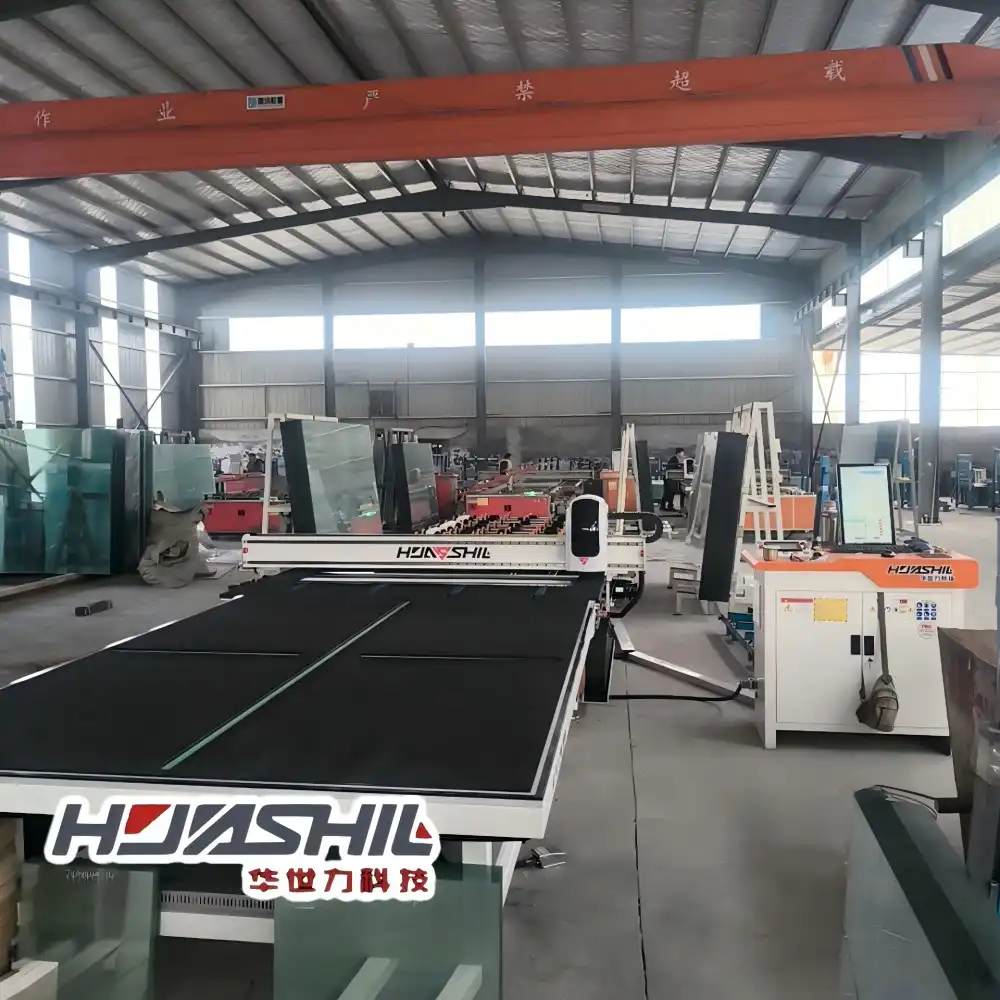
Plant managers can assess equipment capabilities versus production needs by understanding the operating sequence. Multiple synchronized phases improve cut quality and throughput.
Glass Stabilisation and Positioning
When operators lay glass sheets on the table, the stability system activates. Our air flotation technique creates a thin cushion that supports glass weight and allows easy installation using properly adjusted air pressure. At appropriate spots, vacuum zones secure the sheet without warping forces. Automatic edge-finding sensors scan the glass perimeter to provide precise position data for the control system to match cutting paths with material edges. Positioning precision is crucial for improving sheet yield.
To prevent sheet shifting, the synchronous belt conveying system moves glass between processing units with regulated acceleration. Conveyor coordination ensures manufacturing line workflow integration.
CNC-Controlled Cutting Execution
Optima-generated cutting patterns are executed by the control system after location verification. This program generates the most material-efficient cutting arrangement based on order criteria, reaching 85-90% yield rates. CNC controllers convert plans into accurate motor commands that operate the cutting head along preset pathways.
Automatic pressure control systems monitor and modify the cutting wheel's downward force. To avoid breakage, thinner glass needs less pressure, while larger sheets need more to score. Sensors monitor cutting resistance to dynamically compensate for sheet hardness fluctuations. Score depth is maintained by adaptive regulation, affecting break quality.
Breaking and Finishing
The integrated breaking table separates glass via controlled bending along score lines after scoring. Mechanical or pneumatic breaking bars under score lines and higher-pressure bars use downward force to neatly propagate cracks through the glass thickness. The breaking procedure is planned to prevent stress in the remaining glass parts.
Advanced tables allow workers to move equipment or modify settings from a safe distance with 360-degree remote control walking. It improves operating safety and production flexibility.
Safety and Quality Control Systems
Modern cutting tables include several safety measures to safeguard people and equipment. When activated, accessible emergency stop systems stop all movements. Moving parts are guarded to prevent accidents, and sensors identify operators in hazard zones. Quality control includes automated measurement verification after cutting to detect dimensional variations before the glass is processed.
Key Factors to Consider When Choosing an Industrial Glass Cutting Table
Choosing cutting equipment entails matching machine capabilities to production demands. This decision-making procedure uses several assessment criteria.
Dimensional Capacity and Material Compatibility
Maximum glass size impacts which projects your facility can do. For 3,660 x 2,800 mm sheets, the equipment can handle both normal architectural glass and huge curtain wall panels. The 2-19mm thickness range covers most architectural, automotive, and furniture glass applications. Thicker glass increases sheet weight; check the weight capacity against material requirements.
Material compatibility transcends dimensions. Low-iron and coated glass require special cutting conditions. Glass laminates require different approach speeds than tempered substrates. Understanding material interactions reduces costly equipment commissioning trial-and-error.
Automation Level and Production Integration
Automation should be based on production forecasts. Manual scoring tables fit variable-order, low-volume task businesses. Mid-volume manufacturers needing consistent quality without complete automation benefit from semi-automated systems. Fully automated tables that link with upstream storage and downstream edging or washing equipment are justified for facilities handling hundreds of sheets daily. Automatic loading in our HSL-YTJ3829 industrial glass cutting table reduces labor expenditures and handling mistakes.
Maintaining material movement across processing stations, synchronous belt conveying systems enable this integration. Consider how equipment links to production infrastructure and if control systems support plant communication protocols while assessing it.
Total Cost of Ownership Analysis
Purchase price is simply one equipment investment factor. Installation, operator training, and production line adjustments cost money. Energy, replacement parts, and preventative maintenance are ongoing costs. CE and ISO9001-certified equipment is reliable and reduces unexpected downtime expenses.
Warranty and after-sales service affect operational continuity. Check replacement parts lead times and technical support, especially for overseas equipment providers. Calculating the total cost of ownership over five years helps financial decision-makers compare equipment choices and justify capital spending.
Maintenance and Safety Best Practices for Industrial Glass Cutting Tables
Sustained performance and operational safety depend on disciplined maintenance routines and comprehensive safety protocols. These practices protect personnel while extending equipment service life.
Preventive Maintenance Schedules
Daily maintenance tasks include cleaning glass debris from work surfaces and vacuum channels, inspecting cutting wheel condition, and verifying lubrication levels in linear guides. Weekly routines involve calibration checks using test cuts on scrap material, measuring actual versus programmed dimensions to detect positioning drift. Monthly inspections examine belt tension in conveying systems, assess pneumatic pressure consistency, and review control system error logs for recurring issues.
Annual maintenance requires more extensive procedures such as precision rail alignment verification, servo motor performance testing, and vacuum pump efficiency evaluation. Establishing documented maintenance schedules and training designated personnel ensures these tasks occur consistently. Many equipment suppliers provide maintenance checklists specific to their models, which should be integrated into facility maintenance management systems.
Operator Safety Training Programs
Comprehensive operator training covers equipment-specific procedures and general glass handling safety. Training modules should address proper glass lifting techniques, personal protective equipment requirements, including cut-resistant gloves and safety glasses, and emergency response procedures. Operators must understand lockout/tagout protocols for performing adjustments during maintenance periods.
Remote control operation features reduce exposure to hazards during setup and troubleshooting. Training should emphasize using these remote functions appropriately rather than bypassing safety interlocks. Regular refresher sessions reinforce safe practices and introduce updates to equipment capabilities or procedures.
Troubleshooting Common Issues
Production efficiency suffers when equipment problems cause unplanned downtime. Common issues include inconsistent cutting quality, positioning errors, and vacuum system failures. Inconsistent cuts often trace to worn cutting wheels requiring replacement or incorrect pressure settings for glass thickness. Positioning errors may result from debris on linear guides or loose mechanical connections. Vacuum failures typically stem from clogged channels, worn seals, or pump performance degradation.
Maintaining troubleshooting documentation that records problems, root causes, and solutions builds institutional knowledge. This resource helps operators resolve recurring issues quickly and informs maintenance schedule adjustments to address failure patterns. Establishing communication channels with equipment suppliers' technical support teams provides expert assistance for complex problems beyond in-house capabilities.
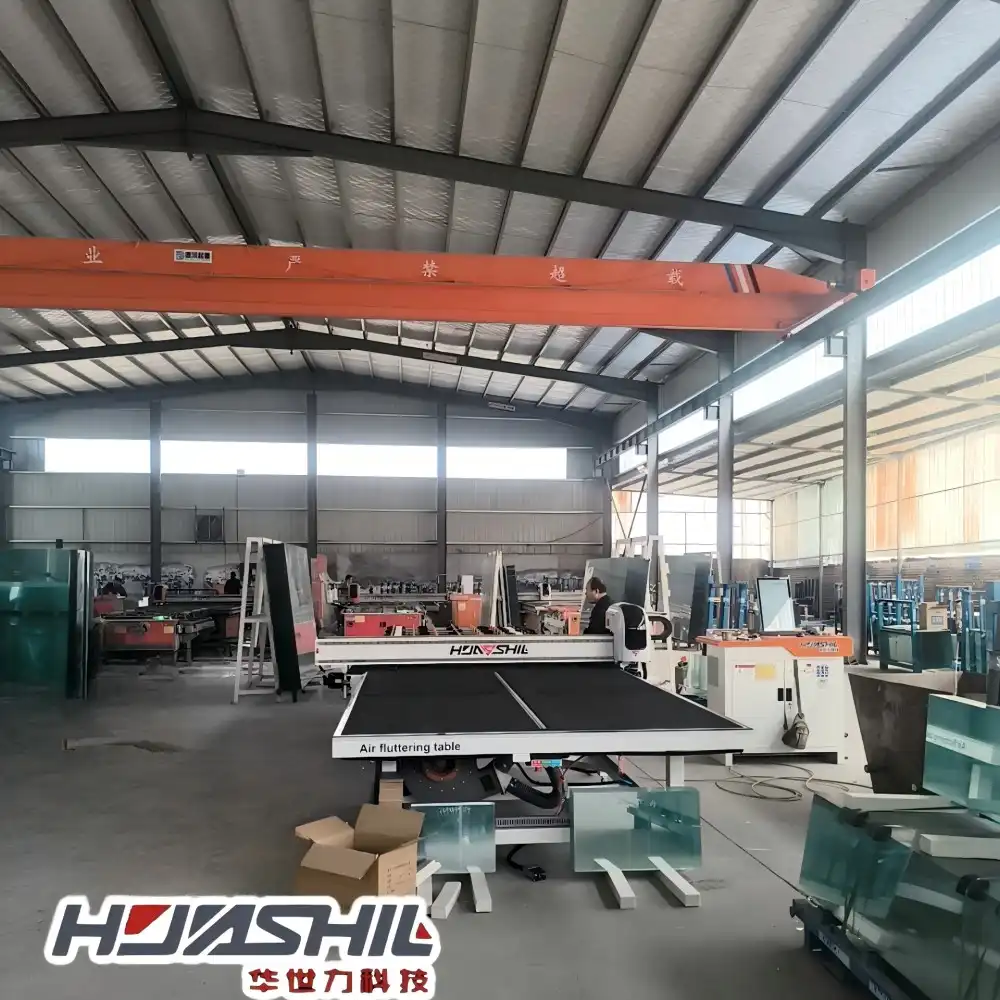
Industry-Leading Brands and Solutions in Industrial Glass Cutting Tables
The glass processing equipment market includes established manufacturers offering diverse solutions tailored to different production scales and application requirements. Understanding the competitive landscape helps procurement teams evaluate options and identify suitable partners.
Global Equipment Manufacturers
International brands like Bottero, LiSEC, and Intermac have built reputations through decades of technological development and installed base performance. These companies typically offer premium equipment with extensive automation capabilities and comprehensive support networks. Their solutions suit large-scale producers prioritizing maximum uptime and integration with enterprise management systems.
Regional manufacturers bring competitive advantages in pricing, customization flexibility, and localized support. We at Shandong Huashil Automation Technology have specialized in glass processing automation for many years, developing industrial glass cutting table equipment that meets international quality standards while offering value positioning attractive to mid-market producers. Our experience serving architectural glass fabricators, curtain wall system integrators, and furniture manufacturers informs product development aligned with real production challenges.
Customization and Service Capabilities
Beyond standard equipment configurations, customization options address unique facility requirements or specialized applications. OEM and ODM programs allow system integrators to incorporate cutting tables into complete production lines under their brand specifications. This flexibility proves valuable for turnkey project contractors serving specific market niches.
Service quality differentiates suppliers as much as equipment specifications. Comprehensive support includes pre-sale consultation helping buyers match equipment to needs, installation and commissioning services ensuring proper setup, operator training programs building competency, and responsive after-sales technical support minimizing production disruptions. When evaluating suppliers, assess their service infrastructure in your region and review customer references regarding support experiences.
Conclusion
Industrial glass cutting tables represent critical investments that directly impact production efficiency, product quality, and operational costs in glass fabrication facilities. Understanding working principles—from glass stabilization through CNC-controlled cutting to integrated breaking systems—enables informed equipment selection aligned with specific production requirements. Key evaluation factors, including dimensional capacity, automation level, material compatibility, and total cost of ownership, guide procurement decisions that balance capability with budget constraints. Proper maintenance practices and safety protocols protect these investments while ensuring consistent performance and personnel protection. As the glass processing industry continues advancing toward greater automation and integration, selecting equipment partners who combine proven technology with comprehensive support becomes increasingly important. The right cutting table, properly specified and maintained, delivers years of reliable service supporting your facility's production goals.
FAQ
Q1: What glass thickness can industrial cutting tables process?
Modern industrial cutting tables typically handle glass between 2mm and 25mm in thickness, though specific ranges vary by model. Our HSL-YTJ3829 cuts glass from 2-19mm, covering most architectural, automotive, and furniture applications. Thinner glass, like 2-3mm, requires gentle pressure control to prevent cracking, while thicker architectural glass demands higher cutting forces. Always verify the thickness capacity matches your production material specifications when selecting equipment.
Q2: How does automatic edge-finding improve cutting accuracy?
Automatic edge-finding uses sensors to detect actual glass sheet positions on the cutting table, compensating for slight placement variations. The system scans sheet perimeters, establishes precise coordinate references, and then adjusts programmed cutting paths accordingly. This automation eliminates positioning errors that waste material and ensures consistent part dimensions regardless of loading variations, particularly valuable in high-volume production environments.
Q3: What maintenance frequency do cutting tables require?
Daily maintenance involves cleaning and visual inspection, taking approximately 15-20 minutes. Weekly calibration checks require 30-45 minutes. Monthly preventive maintenance, including lubrication and detailed inspections, takes 2-3 hours. Annual comprehensive service by qualified technicians typically requires 6-8 hours. Following manufacturer-specified schedules prevents unexpected downtime and maintains cutting precision throughout equipment service life.
Ready to Upgrade Your Glass Processing Capability?
Shandong Huashil Automation Technology combines advanced engineering with practical production understanding to deliver glass cutting solutions that meet demanding fabrication requirements. Our HSL-YTJ3829 cutting table accommodates glass up to 3660×2800mm with a thickness range from 2-19mm, featuring Optima optimization software that maximizes material yield. Integrated automation, including automatic loading, pressure control, and edge-finding, reduces labor requirements while improving consistency. The air flotation system and synchronized belt conveying ensure gentle material handling, minimizing breakage losses. CE and ISO9001 certifications confirm our commitment to international quality standards, backed by comprehensive technical support. Whether you need standalone cutting equipment or integrated production line solutions, our engineering team works with you to configure systems matching your specific applications. Contact our team at salescathy@sdhuashil.com to discuss your glass processing needs with an experienced industrial glass cutting table supplier who understands the challenges facing architectural glass fabricators, curtain wall producers, and furniture manufacturers throughout the United States market.
References
1. Glass Processing Handbook: Modern Cutting Technologies and Automation Systems, International Glass Industry Association, 2022.
2. Precision Manufacturing in Architectural Glass Fabrication: Equipment Selection and Process Optimization, Journal of Manufacturing Technology, Volume 34, 2023.
3. CNC Control Systems for Glass Processing Equipment: Principles and Applications, Advanced Manufacturing Research Institute, 2021.
4. Safety Standards for Industrial Glass Cutting Operations: OSHA Guidelines and Best Practices, Occupational Safety and Health Administration, 2023.
5. Total Cost of Ownership Analysis for Glass Processing Equipment Investment Decisions, Industrial Equipment Procurement Journal, 2022.
6. Maintenance Management Strategies for Automated Glass Fabrication Systems, Manufacturing Maintenance Technology Review, Volume 28, 2023.
