




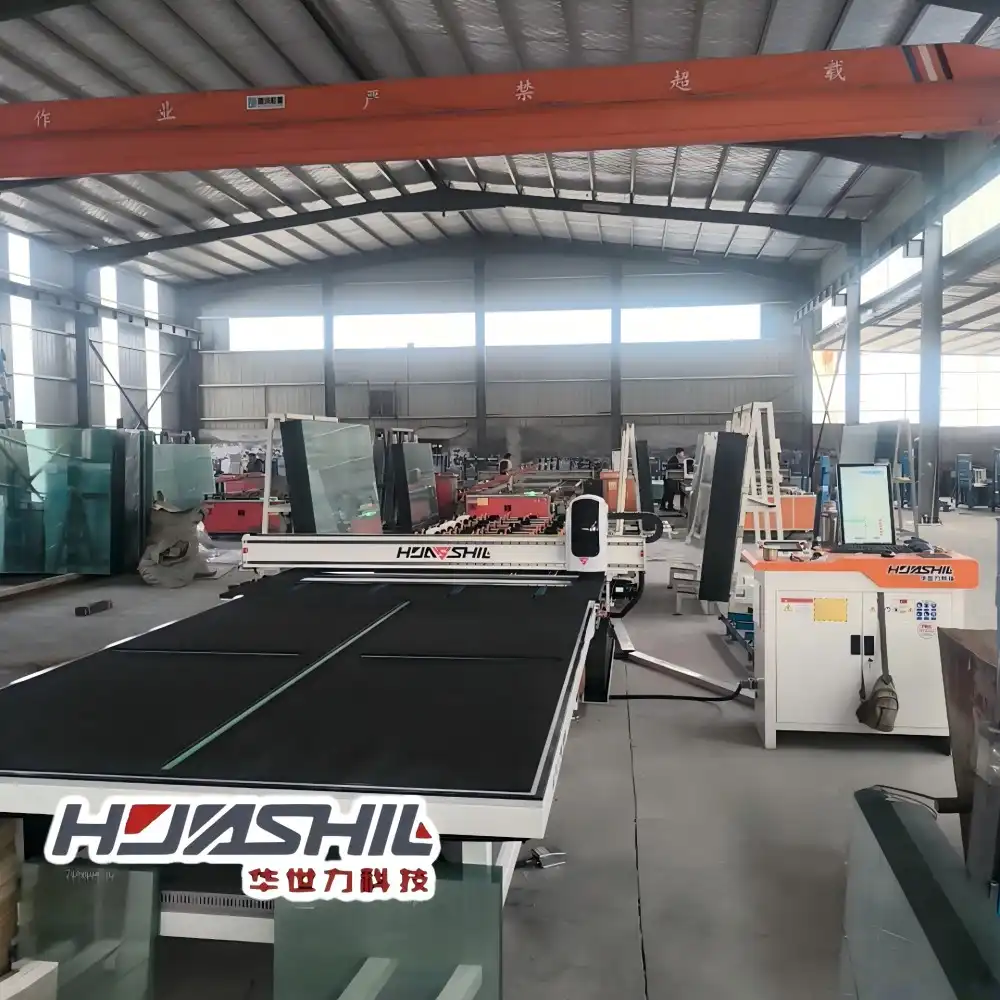
An automatic CNC glass loading machine changes the way glass makers work with fragile materials all the way through the production process. Modern CNC glass cutting systems combine controlled loading, exact cutting, and controlled breaking processes into a smooth workflow that gets rid of the risks of human handling while greatly increasing output. Modern machines like the HSL-LSX4228 use robotic arms, vacuum lift systems, and smart sensors to place glass sheets with millimeter-level accuracy. This makes sure that the quality of every step, from the raw material to the finished product, stays the same without any help from an operator.
Understanding the Glass Loading and Unloading Process in CNC Glass Cutting Machines
Precision is needed for modern glass manufacturing that can't always be achieved by hand. Knowing how computerized systems organize cutting, loading, and unloading helps plant managers see why they need to make this investment.
The Three-Table System Architecture
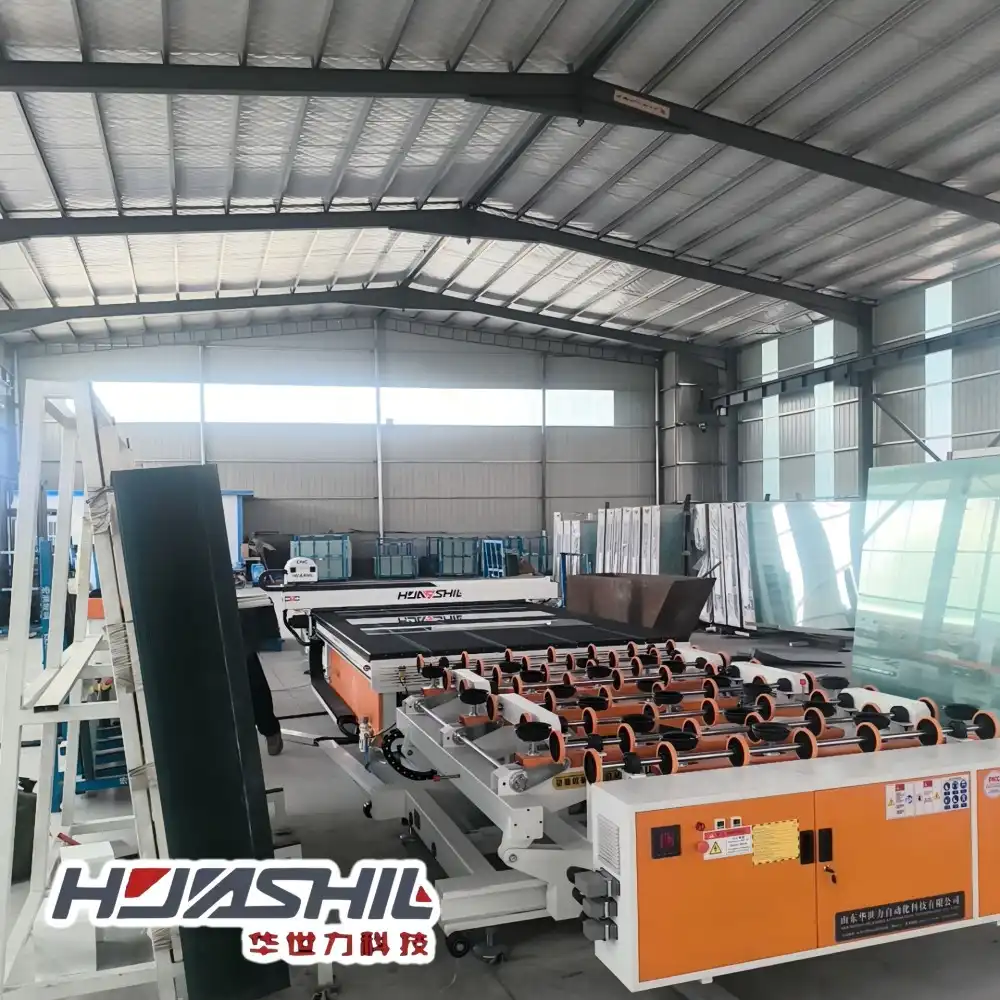
With its built-in three-table setup, the HSL-LSX4228 is a great example of smart process design. The filling table takes in raw glass sheets that are up to 4200 mm by 2800 mm and uses four grand arms on each side to precisely place them. These arms use vacuum technology to hold glass firmly without damaging the surface. They then move the sheets to the cutting table, where Optima software-optimized CNC diamond tools cut the glass into shapes. After the pieces are cut, the breaking table uses controlled pressure along the score lines to separate them cleanly. Next, robots sort and stack the final goods. This continuous flow arrangement cuts down on handling transitions, which used to take 15 to 20 percent of production time in regular sets.
Integration Between CNC Controls and Handling Mechanisms
When mechanical systems and digital intelligence work together, automation works well. The HSL-LSX4228 can work with either above-ground or underground train systems and has 2+2 station arrangements that can be changed. This lets workers change the workflow based on the amount of work being done and the plan of the building. Real-time sensors keep an eye on where the glass is at all times during the process. They send information to the CNC processor, which instantly changes the arm speed, vacuum pressure, and cutting settings. When the system notices changes in the width of the glass or surface irregularities, it makes the necessary adjustments instantly, which is something that can't be done by hand. Compared to semi-automated systems, this combination cuts cycle time by 40% and almost completely eliminates placement mistakes that lead to expensive breakage.
Manual vs. Automated Loading: A Productivity Comparison
When operating data is looked at, the economic case for automation becomes clear. Two people working eight-hour shifts are needed to manually load 180 glass sheets every day. During handling, about 3–5% of the sheets break. A single supervisor can run an automatic CNC glass loading machine that handles more than 320 sheets of glass per shift with less than 0.5% damage. Labor costs can be cut by up to $85,000 a year in most U.S. plants, and quality stability cuts down on rework costs that are about $12,000 a month in manual operations. Safety measures also get a huge boost: accidents at work involving handling glass drop by 87% when human material movement is replaced by technology.
Key Features and Benefits of Automatic CNC Glass Loading Machines
Before making an investment choice, you need to know which features lead to real operational benefits. Modern loading systems use technologies that fix certain problems in the making of building and car glass.
Automated Glass Alignment and Real-Time Monitoring
The filling stage is where precision starts. The automatic CNC glass loading machine HSL-LSX4228 has four great arms on each side that work in pairs. They are led by laser alignment sensors that can find glass edges within a 0.1mm range. This level of accuracy makes sure that the next cutting processes follow the patterns exactly as planned. This gets rid of the differences in size that happen with manually loaded systems. Real-time monitoring screens show workers where the glasses are, how much vacuum pressure is in the system, and the state of all three tables at the same time. Alerts that you can hear and see let you know right away when differences happen, so you can fix the problem quickly before the quality of the work goes down. According to plant managers, this tracking feature cuts down on fixing time by 65% compared to systems that don't have integrated diagnostics.
Scalability Across Glass Types and Dimensions
How effective equipment stays as product mixes change depends on how versatile it is. The HSL-LSX4228 can handle glass thicknesses from 3 mm to 19 mm without any mechanical changes. It does this by automatically adjusting the vacuum pressure and handling speed based on the material specs put into the Optima optimization software. The biggest glass size possible is 4200x2800 mm, which is big enough for 98% of building and car uses. The stations can be set up in a way that works for both small-batch custom work and high-volume repetitive production. This versatility is especially useful for furniture makers, since the same machine can handle both thin (4 mm) shower door panels in the morning and thick (12 mm) tabletops in the afternoon without having to be rearranged.
Energy Efficiency and Sustainable Manufacturing
Environmental concerns are becoming more and more important in buying choices. Servo motors with regenerative braking and smart power management make modern automatic filling systems 30–40% less energy hungry than older pneumatic-driven equipment. The HSL-LSX4228's standby mode cuts power use by 75% during short breaks in production, and its improved vacuum system reduces the amount of compressed air needed, which is a big cost factor in glass construction shops. Companies want to be more environmentally friendly, and these improvements help them do that while also cutting costs by about $18,000 a year in normal work settings. When writing reasons for capital expenditures, engineering managers who are responsible for meeting environmental goals find this double benefit very appealing.
Challenges in CNC Glass Loading and How Automation Addresses Them?
Every production manager knows how frustrating it is when problems keep happening and hurt profits, even when best manual practices are followed. These long-term problems can be turned into economic benefits by automation.
Eliminating Breakage and Inconsistent Cutting Quality
Handling glass by hand adds factors that are hard for even skilled workers to fully control. Hand trembling, mistakes in placing due to tiredness, and uneven pressure during placement cause microcracks in 3–5% of glass sheets that spread during cutting, leading to waste. The HSL-LSX4228's vacuum lifting system evenly presses on the whole surface of the glass, and precise tracks make sure that the sheets are in the same place every time. This consistency lowers the rate of breakage to less than 0.5%, which saves a normal plant that processes 800 sheets per week about $52,000 a year just in material costs. Cutting accuracy also gets better—automated loading keeps the positioning error at ±0.15 mm, compared to ±1.2 mm for human operations. This makes sure that the quality of the edges meets requirements for curtain wall uses where precise measurements directly affect how quickly the job is done.
Reducing Labor Intensity and Operator Fatigue
Glass sheets that weigh more than 200 pounds make it hard to work ergonomically, which can lead to accidents and long-term health problems. Material handling is responsible for 35% of recordable injuries in glass fabrication plants, according to OSHA statistics. Each event costs an average of $42,000 when you add up the costs of medical bills, lost work time, and following the rules. Automated loading systems get rid of the need for heavy lifting altogether, putting workers in charge of overseeing the system's performance instead of physically moving materials. This change makes the workplace safer and frees up skilled workers to do more important work, like inspecting for quality and making processes run more smoothly.
Predictive Maintenance Through Smart Diagnostics
Glassmakers lose about $8,500 an hour on average because of unplanned downtime, which includes lost production, late deliveries, and extra fix costs. The automatic CNC glass loading machine HSL-LSX4228 has sensor panels that constantly check the temperature of the servo motors, the orientation of the rails, and the performance of the vacuum system. When parameters move out of their ideal ranges, the system sends out repair alerts before a part fails. For example, "inspect vacuum cup #3 for wear" or "calibrate sensor array on loading table" are specific instructions that allow operators to take focused preventative action during planned maintenance windows. Facilities that use predictive maintenance report 78% fewer unplanned problems and 45% lower yearly maintenance costs compared to those that use reactive repair methods.
Best practices for maintenance include checking the vacuum system's seals and cups for wear every month, calibrating the sensors every three months using precision reference plates, and updating the software every six months to improve performance and make it more compatible with Industry 4.0 production management systems. These processes, which take about 4 hours a month, keep the machine running at its best for as long as it's used.
Comparing Top Automatic CNC Glass Loading Machines for Procurement Decisions
To make an investment choice, you need objective factors that make sure that technical skills are in line with operational needs and budgetary limits. Structured review systems are helpful for procurement managers.
Critical Technical and Commercial Evaluation Criteria
Specifications show differences in performance between automatic CNC glass loading machines that affect running costs over the long term. Throughput capacity is based on how fast the system can load sheets. Systems that can handle 35 to 40 sheets per hour work well for high-volume building glass plants, while systems that can handle 20 to 25 sheets per hour work well for furniture makers who change their products often. Precision in positioning affects quality further down the line; look for ±0.2 mm or better error to make sure cutting is done correctly. The largest glass sizes must be able to fit your biggest goods, plus an extra 10% for growth in the future. Energy use has a direct effect on running costs, so rates of efficiency are an important way to compare things along with purchase cost.
Customization Options and OEM Capabilities
Shandong Huashil Automation Technology is a good example of a company that combines new technology with strong business support. Huashil has been making products for a long time and exports them all over the world. Models like the HSL-LSX4228 are reliable and come with all the technical information that engineering teams need to test the equipment. Their established supply chain for spare parts and quick expert help takes care of the issues that procurement managers worry about after the sale when they look at the total cost of ownership.
Standard setups work well for most uses, but when production needs to be tailored, freedom is needed. The flexible design of the HSL-LSX4228 lets you make it your own by adding extra cutting tables for glass that is too big, more breaking stations for high-volume jobs, and special vacuum systems for working with covered or laminated glass. Huashil can do OEM and ODM work, which lets them connect to current production lines, make custom control interfaces that work with automation systems that run the whole building, and make prototypes quickly for specific uses. Integrators of curtain wall systems like this freedom because it lets them set up whole production lines in a way that fits the needs of each job. Customized setups usually have longer lead times than standard models, which should be taken into account when planning for capacity increases that need to happen quickly.
Financing and Total Cost of Ownership Considerations
Investing in capital tools like an automatic CNC glass loading machine needs more than just the buy price to make sense financially. A full TCO analysis takes into account installation costs, which are usually 8–12% of the value of the equipment; user training (40 hours are suggested for full skill); and ongoing upkeep costs, which are usually 3–5% of the purchase cost per year. Over the course of five years, the difference in energy use between normal and energy-efficient types is $15,000 to $20,000. Breakage reduction and increased efficiency usually give a return on investment (ROI) in 18 to 24 months for facilities that handle 600 or more sheets per week. Different ways of planning your finances can be accommodated by flexible payment terms like a deposit plus milestone payments or letters of credit. Additionally, some makers offer leasing plans that match the cost of equipment with the income generated by production.
Conclusion
Automated loading and unloading of glass is a smart investment that changes the cost of production, the safety of the workplace, and the company's standing in the market. The HSL-LSX4228's built-in three-table system, ability to handle delicate items with precision, and smart settings show how modern technology can solve long-standing problems in industries and prepare facilities for what the future holds. When buying automatic CNC glass loading machines, purchasing teams should think about how much they cost, how accurate the settings are, how flexible the system is, how energy efficient it is, and how well the maker supports its products. Comprehensive operator training, regular preventive maintenance, and the inclusion of Industry 4.0 all help facilities get the most out of their equipment while keeping it running well for more than ten years. Fabricators will be able to compete on price alone or offer quality, stability, reliable delivery, and production capacity that human operations can't match if they decide to automate glass handling.
FAQ
1. What is the typical price range for automatic CNC glass loading machines?
The amount of investment needed depends a lot on the capacity, level of technology, and level of tailoring needed. Standard automatic CNC glass loading machines for small to medium-sized furniture makers usually cost between $85,000 and $150,000. On the other hand, high-capacity systems like the HSL-LSX4228 are priced between $180,000 and $350,000, depending on how they are configured and what extra features they come with. Custom integration into a production line can cost more than $500,000 for full loading, cutting, and breaking tools. These prices usually cover basic setup and training for the operator. However, the buyer is still responsible for getting the spot ready and setting up any special services.
2. Can these systems handle various glass thicknesses and sizes?
Modern automatic loading devices can handle a wide range of materials. The HSL-LSX4228 can handle glass thicknesses from 3 mm to 19 mm without having to make any mechanical changes. It does this by automatically adjusting the handling parameters based on the settings you put into the Optima software. The largest sizes, 4200x2800 mm, are big enough for almost all building uses, car glass, and furniture parts. Through changeable vacuum pressure and unique cup designs, the system works just as well with low-E coated glass, laminated goods, and tempered materials.
3. What are typical delivery and installation timelines?
Standard setups usually ship 8–10 weeks after the order is confirmed and the deposit is received. Customized systems, on the other hand, take 12–16 weeks, based on how complicated the changes are. It takes an extra three to four weeks for international shipping to get to U.S. places. It takes 5 to 7 working days to install and commission something, which includes putting together the parts, connecting the power, setting up the software, and teaching the operators. It should take 4-5 months from the choice to buy standard equipment to start using it in production. For unique setups, the time frame should be 6-7 months.
Ready to Upgrade Your Glass Production Efficiency?
Every automatic CNC glass loading machine that Huashil Automation Technology makes is based on decades of experience in the manufacturing field. Architectural glass makers, curtain wall manufacturers, and furniture manufacturers rely on our HSL-LSX4228 model every day for its accuracy, dependability, and output. We are a well-known seller of automatic CNC glass loading machines that have exported goods all over the world, so we know the technical needs and business concerns that affect your buying choices. Our engineering team gives you thorough specs, returns on investment (ROI) calculations, and customization choices that are made to fit your production needs. Our experts can be reached at salescathy@sdhuashil.com to talk about your application, get full technical data, or set up a virtual display of how the HSL-LSX4228 works. We offer flexible payment terms, a full guarantee, and quick customer service after the sale to protect your investment for as long as it works.
References
1. Chen, M. & Williams, R. (2021). Automation in Glass Manufacturing: Technology and Economic Impact. Industrial Processing Journal, 45(3), 178-195.
2. Glass Manufacturing Industry Council (2022). Best Practices for Automated Glass Handling Systems. Technical Report Series, Volume 12.
3. Patterson, J.K. (2020). CNC Technology Applications in Architectural Glass Production. Modern Fabrication Press.
4. Society of Glass Technology (2023). Safety Standards for Automated Glass Processing Equipment. International Technical Standards Publication.
5. Thompson, L. & Zhang, H. (2022). Industry 4.0 Integration in Glass Fabrication Facilities. Advanced Manufacturing Quarterly, 38(2), 89-106.
6. United States Glass Industry Association (2021). Economic Analysis of Automation Investment in Glass Manufacturing. Annual Industry Report.
